Showing posts with label Culture. Show all posts

How to become a fighter?

I was in Bidar district in north Karnataka (India), to evaluate the disability programme of ORBIT an organisation working for different groups of marginalized persons and watershed management. I went around the villages to meet the self-help groups of disabled persons.

Faint echoes of the anti-corruption campaign launched by Anna Hazare reached us, while I had my personal encounter with the small level corruption that permeates the life in India. It was difficult to find someone completely blameless in the corruption cycle. Is corruption justified if you are so poor that you can't have a life of dignity?

The Indian law asks for 3 percent of Panchayat budget to be reserved for persons with disabilities and persons with certified disabilities have right to receive pension, based on the degree of disablement.

"Persons in the Panchayat want bribe for giving any funds from the 3% reserved budget", "to get disability certificate you have to pay bribes", "to get disability pension they ask for bribes", were the frequent refrains. But persons asking for bribes were not just petty officials who rule the village lives. They were also village rehabilitation workers, persons who also had disability and who knew the challenges faced by other disabled persons in those villages.

And the poor disabled persons in the villages, if they could, were some times happy to manipulate and tell lies, so they could get additional benefits. How do you eliminate this corruption that does not spare anyone?

"But you are not few, if you all unite and ask for your rights, can't you fight this corruption?", I asked to one group headed by a small woman with sandalwood marks on her forehead, whose son was disabled.

"Alone we can't do any thing. We are weak and we need your help", she said and other persons in her group nodded in agreement.

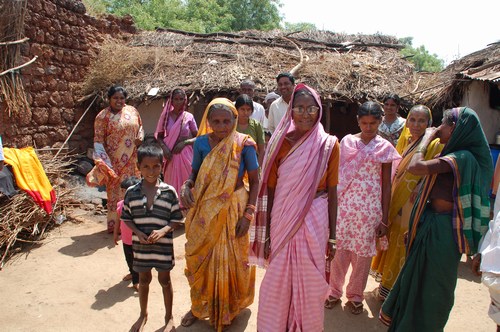
Yet there were persons like Hashmat Bi, an elderly woman heading a group in another village. A childless first wife who also had disabilities due to leprosy, she had an infectious laugh. "I always fight, till they give up", she said simply, a natural leader. The bus drivers didn't want her and other disabled persons in their buses, but she fought till they gave in. Panchayat and district officers, in the end everyone gave in to her determined fights. In their group, everyone gets pension and she has used the Panchayat funds for starting different schemes in their village.

Hasmat bi, Bidar district, India

How can you make people become fighters for their rights like Hashmat Bi?

***

Film director Onir - Florence Interviews (3)

Note: In December 2010, during the River to River film festival in Florence (Italy) I did brief interviews with Aparna Sen, Rahul Bose and Onir. All the three interviews were very satisfying because each of them gave me an opportunity to meet and get to know some lesser known aspects of people I have liked and admired. However, I am really pleased with this Onir interview because it talks of some issues that resonate emotionally with me. I have also contributed to his new film "I am" by helping with the Italian subtitles.

Interview
Sunil: Let us start with your new film "I am". The film was supposed to have five stories but in the end it has only four stories, what happened?

Film director from India, Onir
Onir: Initially I was thinking of five stories. However, when I made the second film, I realized that it was going to be difficult because I wanted the entire film to be less than two hours. For the five stories, the time needed would have much more so I decided to limit it to four stories.

Sunil: How did you decide which story to not to use in the film?

Onir: The story I discarded, I was not too happy with the way it was shaping up. I felt that that story needed more space, it needed a full length film just for itself, to do justice to it.

Sunil: Among the four stories of "I am" - Afia, Megha, Abhimanyu and Omar, do you have a favourite?

Onir: I can't say! All the four are stories that I wanted to make into films. When it was difficult to get separate finance for each of them, I decided to make them together. Each part of the film has its own distinct character, mood and style, so each of them is special to me for a different reason.

Sunil: You were born in Bhutan, so that means you are a world citizen. From a family that is originally from Bangladesh, then born in Bhutan and now settled in India. Increasingly, we all have mixed roots and identities.

I have been to some Nepali refugee camps where they had persons who were thrown out of Bhutan, so I am aware of some of the issues involved in this. You have been a migrant. What does that mean to you?

Onir: My leaving Bhutan was linked to the Nepali exodus. My father was principle of a school where they had Nepali children. There ten Nepali students were arrested and next day they were found hanging. So my father resigned and moved to Kolkatta.

Though I was born and brought up in Bhutan, they decided that people who are not of Bhutanese origin, will be second class citizens in that country, so we had to decide what to do. I didn't want to be a second class Bhutanese citizen, I preferred to be Indian citizen. However, when I talk of home, in my mind, my home is the place in Bhutan where I was born and where I grew up.

Due to this reason the story of Megha in "I am" is very special to me, because it is about homelessness. When I came to Kolkatta, though I was a Bengali, I was an outsider. Then I went to Berlin, and there of course, I was even more of an outsider. Then I came and settled in Maharashtra, where language and other things make me a little outsider.

I agree with you that where ever you live becomes a home, and at the same time, you are always an outsider.

I have some very very good friends in Berlin from the days when I was a student there. So there I feel absolutely at home with them, and with them I don't feel that I am an outsider. But at the same time there are things - like the time when there was this bomb blast in London. I was travelling in Berlin in the S-Bahn and suddenly I realized that I was the only brown person on the train and everyone was looking at me. So it was a kind of strange feeling that I had.

But I also have such feelings in Bombay when ever there were those Maharasthrian things .. I travel a lot by local trains and I feel that if you don't know the local language, then the place is not as friendly. Where ever we are, at the time of conflicts you realize that you are an outsider.

Sunil: Did you ever go back to Bhutan?

Onir: That experience is what has influenced Megha's story in "I am". In the story she is back home after twenty years. I had gone back to Bhutan after about thirteen years. Emotionally it was a very exhausting period, to go to the same old house and find other persons staying there. At the same time, there are so many things from your memories that are still the same there. But after that one experience, I didn't want to go back there, because emotionally it was very painful.

Sunil: Salman Rushdie in one of his books had written about "imaginary homelands" that we emigrants carry in our hearts, but these homelands are only spaces in fantasies, because when you do go back, you realize that it is not the same place anymore.

When I go back to places of my childhood, the differences between the reality and my memories always strikes me. Like to go back and find that the "big square" of my memories is actually a narrow little space. Did that happen when you went back to Bhutan?

Onir: I realized that all my friends were gone and the few there were .. in Bhutan, people get married very early, so there were these old friends with three kids and I realized that our worlds had grown apart a lot.

When I went to our old house, I immediately spotted this tree, I loved gardening and I had planed that tree, to see it was very emotional, though it was a small thing. Then inside the house, where we had our fireplace, the hole above it for the smoke was still there, though they had shifted the fire place .. so there were so many small things that brought back old memories.

Film director from India - Onir

Sunil: Your decision to get in to films came at a time when the TV and media revolution had not yet taken place. So how did your family react to it?

Onir: My parents were keen that I become a doctor. They wanted one son to become a doctor and the other son to become an engineer. After school, I came to study in Kolkatta and my father got me admission in the science college. He was thinking that after the science college I will try to go to the medical college. After he went back, after one week I applied for a literature course in another college. I shifted there and only after my name was cut off from the science college, I told my father.

So first there was shock in the family that I was doing literature and arts. Then I started doing very well in literature so my father was happy, he started saying that I will become a professor. Then one week before the finals of my post-graduate course, I quit and came to Berlin to study cinema and that was another shock to them. They were worried that we had no connection in Bombay or in the film fraternity, and Bombay is a very family driven industry, so were worried.

When I managed to my first film, it took me ten years to do it in Bombay .. I knew that this was my goal. I also knew that it will take time, and I was patient. I never thought, oh my god, it is taking me so long, etc. I knew that I was going to do it. When they finally saw my film ... and even now, they know that I have zero savings, I don't have a house, I don't have a car, what ever I earn goes back into film making because that is what makes me happy .. but now I find that they are happy about my work and they share my happiness when my films get made. I know that they are worried, but they are also proud of me.

Sunil: Did their other son become an engineer?

Onir: Actually he went into research. He did do computer engineering, but he liked physics. He went to do physics at Presidency college and I know that my parents are very proud of him. He has recently won the highest award that a scientist can get in India. I don't remember the name of the award, but it was given by the Prime Minister of India, about one month ago. He is very well known in his field of work.

My parents never really pushed us .. and now they are happy about both of us.

Sunil: You said that they were happy when they saw your first film, but that film (My Brother Nikhil - MBN) had a theme that may not have been very easy for your parents?

Onir: I was also worried about their reaction .. regarding the sexuality issue. My mother called me from Kolkatta. I was in Bombay and she had just seen the movie and was in tears. And she said, "..but couldn't you get a better looking man opposite Sanjay?" (laughs) And my father said, "I was never so nasty as a father" (laughs) and I had to explain that film's father was not you. Their reaction was very interesting.

About my dad, I was very moved because I had gone to New York for a screening of MBN and at the same time there was the first GLBT film festival in Kolkatta and my father went there. He went up on the stage and said, "I am very happy that you are giving him an award but I would rather you all paid a ticket and went to see the film in cinema theatre and not to see it free here."

Sunil: Actually when I had seen MBN, though it was a daring theme in Indian cinema, I had also thought that to show he is gay with a very strict authoritarian father was a kind of stereotyping. Another thing that had struck me was in terms of film's structure, I had thought that it very similar to an American film called "Jia" with Angelina Jolie.

Onir: It is interesting that you are pointing this out because people have compared MBN with Philadelphia. They were on the similar theme, but in terms of films structure, MBN was inspired from "Jia". I had been thinking, how do I make this film when I don't have much budget, how to tell this story. From "Jia", I got the idea of docu-fiction, though the idea that people are talking about a person, whom they had loved and who is dead ...

Sunil: I had felt that "Jia", though similar in structure, differed from MBN in an important aspect. In the sense that in "Jia", each person talking about the character played by Angelina Jolie presents a very different person, it was as if she showed a different aspect of her personality to different people, while in MBN, the vision of Nikhil by the different people was really similar...

Onir: Yes, we didn't take any story idea from other films, we just took the idea of docu-fiction and other persons talking about Nikhil, mainly his sister talking about him ...

Sunil: You have also been a song-designer for "Daman". What does that mean, to be a song-designer?

Onir: I had first done some song editing for Kalpana (Lajmi) and it was my first film work. When she started "Daman", she asked me to be the editor and it was my first film as an editor. For me it was an important step to get into films. I had liked her "Rudaali" and "Ek pal". As an editor I wanted to be on the sets and see what was happening, even if most editors don't do that. I knew that I wanted to be a director, so I wanted to see and learn as much as possible. So when she asked me, "Do you want to come" I said, "Of course and I will give whatever help I can give".

She knew that I had a sense of the music, so she asked me, "Do you want to direct the songs" as she didn't have money for a choreographer. I immediately said yes.

Before that I had already produced two music albums with Pritam. I had brought Pritam in film industry. Even there, he was composing the songs while I was a kind of song designer. There are different elements in the songs, and a song designer influences how those elements shape up, there were a lot of discussions and I was also involved in those. Decisions like what kind of singers, how many singers, what kind of instrumentation, what kind of song, etc. So I was part of the song design.

In "Daman" I was involved not only in the process of music recording, I also went on the sets and started shooting the songs. This experience with Kalpana was great because she had a small unit. Most of the assistants there were working on the film as a job, but they didn't have the passion. I was waking up early, I used to go to the sets take care of the art, check the costumes, etc. I didn't want more money but I wanted to learn as much as possible from all the different departments. So that when the time came for me to my film, I will be less dependent upon others.

Film director from India - Onir

Sunil: There was an interview of another person from south, who has worked with you on "I am" ..

Onir: Sandip

Sunil: In this interview, he had said that you are very well organized and you plan every thing in advance. Do you think that you are a "perfectionist" kind of person who wants to control every thing?

Onir: It is more about planning .. I have always been the producer of my films. And I have always made my films with extremely tight budgets. "I am" was shot in 24 days and MBN was shot in 28 days. For me planning and preparation means that I am not sitting on the sets wondering what to do next, what shot to take, etc. All that has already been planned and on the sets, I do a lot of home work. On the sets, I spend more time with my actors to prepare them for the scene.

Money and time are important resources, it is extremely important to respect what you have and to get the best out of it. For this self-discipline, I thank my Berlin days. Discipline is something I learned there.

Sunil: You also did some work for Ram Gopal Varma?

Onir: I did editing of some promos for his film "Bhoot". It was a nightmare working for him but any way ..

Sunil: I think that it is appropriate that working on a theme like Bhoot (ghosts), you have nightmares .. but my question is about other film makers and how they have influenced you?

Onir: I don't have an icon or an idol. I love the works of lot of different people who are good film makers, ... but the person who really inspired me to get into films was an experience when I was very young. It was because of the images from that film that stayed with me, very strong imagery that made me dream and want to become a part of films. That was Shyam Benegal and the film was Junoon. I was really young at that time and I didn't understand so much, but the visual impact was so strong that it made me desire to become part of the films ..

Sunil: Junoon was good .. I remember its premier at Chanakya in Delhi, where Shyam Benegal had come with Shabana Azmi and Deepti Naval... I read some where that you have some three old scripts and you are working on one of them with NFDC?

Onir: It was my first script and now I am reviewing it .. NFDC has been a partner in developing that script and I am planning to make it after "I am".

Sunil: Are there other old film scripts that are waiting to be made into films or are they part of a development process?

Onir: They are not ready for developed into films .. they keep on getting modified. I always keep on writing. I can't sit idle. When I am waiting for something, I will start writing. I write new scripts, I develop ideas, may be some of them will some day become films, may be not ..

Sunil: I wish you would make a musical. I like the music of your films. I loved the music in MBN.

Onir: MBN was at Milan GLBT film festival and it won the audience choice award. I remember the next day, a group of Italian men came to me and started singing "Le chalo ..", it really touched me.

Sunil: OK Onir, thanks for this interview. I really enjoyed talking to you.
Rahul Bose - Florence Interviews (2)

Rahul Bose, 43 years old, is known for his subtle and understated roles in many films such as Mr. and Mrs. Iyer, The Japanese Wife, Shourya, etc. He had directed "Everybody says I am fine" and is supposed to direct, "Moth smoke" (based on a book by Mohsin Ahmed). He has also played in the Indian national Rugby team for many years.

Rahul Bose, actor and director from India
I had the opportunity to meet and interview Bose during the River to River film festival in Florence (Italy) in December 2010. In the festival there was four of his films - Split wide open, Every body says I'm fine, The Japanese wife and I am. I had spoken to him before "I am" was shown in the festival.

Here is a transcript of my talk with him, that focused mainly on his work with voluntary organisations and only briefly touched some issues related to his films.
***

Sunil: I am curious about your role in Onir's "I Am". I know the screen play of "I am" because I did the Italian subtitles of of that film. It has four stories - Afie, Megha, Abhimanyu and Omar. In which of these four stories you play a role?

Rahul: I am in "Omar" but I am not Omar, I have the other guy's role.

Sunil: Can you say something about this role?

Rahul: This part deals with homosexuality, related to the judgement on the abolition of section 377, which decriminalized homosexuality in India. My part of the film looks at that. It looks at life before the judgement and after the judgement. It is about the discrimination and terror inflicted on homosexuals.

Sunil: This is not your first time with Onir, you were also there in "Bas ek pal"?

Rahul: No, this is my first time with Onir.

Sunil: I read your article in Tehalka magazine a few months ago, about raising funds through an auction. Then I also read about some work that you did in leading a group of non-governmental organisations (NGOs) in Bombay.

Rahul: That was the "group of groups". We had formed it after the tragedy of 26/11 so that we could get together and speak with one voice to the Government. There were a lot of groups that were speaking at that time, but we were all speaking with different voices. So our attempt was to get everyone together. We had worked very hard and in the end we had 52 groups under one umbrella. But like all things, the work needed to keep something like this going on, is so tremendous that after about 6 months, it fell apart.

Sunil: What kind of things this group was trying to achieve?

Rahul: So many issues linked to 26/11, like asking for police reforms ..

Sunil: In the sense of the outcry that happened after 26/11?

Rahul: Yes, but we wanted to give it a more secular and tempered response, by looking ahead and not reacting in a knee-jerk manner by blaming people and other nations unnecessarily. So it's aim was to try to speak in one voice and to speak in a temperate reasonable voice as citizens of a city that wants to say things to the Government ..

Sunil: But the kind of things that are allowed to happen in Bombay, they are so negative, and where Government does not step in, it does not do anything to stop those groups .. so what can you expect from that kind of Government?

Rahul: Whatever the Governments do or don't do in Maharashtra, it is important that they are made aware that there is an active citizenry that is watching, controlling and is going to speak about it. Just doing that is important. I am not saying that it made a big difference, but our idea was to tell them that we are here, we are listening and watching, and that we are angry. We want good governance.

We don't need 26/11 to ask for better governance. The city has had a very patchy record of good governance. Politically it is a hot bed.

Sunil: Tell me about your foundation.

Rahul: My foundation is called "The Foundation". I was raising money for this foundation through India's first sports' auction. We had 25 pieces from 25 Indian world champions, and we raised money for the foundation.

Sunil: What does the Foundation do?

Rahul: It has two initiatives - REACH and HEAL.

REACH is about restoring equality though education for advancement of children. We have given scholarships to 6 children in Andaman and Nicobar islands, to study at the Rishi Valley school outside Bangalore. The idea is to empower children, who otherwise would never leave their communities. They are getting education at a world class institution, so that they can one day get into mainstream of India's economic life and hopefully they will also take their learnings to their communities, or they can go anywhere in the world. But we never see anyone from Andaman Nicobar in any jobs in mainland India. So it is my wish that these children will become a bridge between people.

But there are different ways to do it and there are different questions. One way could be to build world class schools in Andaman and Nicobar, but then that won't really bring those children out of Andaman to go to the rest of India and become part of mainstream economic life.

Now we are looking at supporting children from another part of the country that is also disfranchised, we want to send children from there to world class schools. The schools have to be chosen carefully and the entire thing takes almost a year to be organised.

The other initiative is HEAL - help eradicate abuse through learning. It is about sexual abuse of children. 53% of all Indian children have some kind of sexual abuse.

Sunil: What kind of data you looked up on this issue? It sounds huge, like almost every second person in India is sexually abused?

Rahul: It is a police data, and it is absolutely shocking. Like most other countries, these are hidden statistics.

Sunil: How long you have been involved in the NGO work? How did it start?

Rahul: I have been involved in it since 2002, after the Gujarat riots. At that time, I began to work with a gender based NGO in Mumbai called Aksharma that worked together with Muslim girls and some Hindu girls, mainly dalits. The idea was to educate them with values of secularism and to empower them slowly, slowly expand their social orthodoxies so that they could attain some kind of status in their communities.

Sunil: This kind of involvement in different issues, has it changed the way you look at those issues, between 8 years ago when you started and today?

Rahul Bose - actor from India
Rahul: Yes, completely. I went into it with good intentions but with little knowledge. As you start to understand how social orthodoxies work, you start to respect the need to change things very slowly without antagonising the other side. For example, you don't want to antagonise the men in a girl's family. She has to go back and live with them, so it has to be done in a way that creates consensus, slowly. There can't be gender equality without men.

One learns, especially in India, that there are complex problems within the problems. It could be income, it can be health. You suddenly realize that the woman can't go out of the house because she is not well, she does not get right kind of food. India is a deeply humbling place, you think that you know things, but you don't. You start appreciating that to bring about any change, you need a long long time and it is never permanent, you always have to go back and look.

Sunil: The children you are supporting in Andman and Nicobar, they come from indigenous families?

Rahul: No, only one of them is half tribal. Out of 550,000 persons in Andmans and Nicobar, only about 35,000 are tribal and so there are about 8,000 tribal children. Rest of the persons came there in different waves of migration. All the children that we support come from modest socio-economic backgrounds.

Sunil: I am asking so many questions about your NGO work, because I work in a NGO too, an organisation that deals with persons affected with leprosy and disabled persons. I just came back from Guwahati, two days ago.

Rahul: I became familiar with Andamans after the tsunami. I made 23 trips there over a period of two and a half years, to organise relief and rehabilitation. I was representing a network of organisations called the Solidarity Initiative. We managed to do a few concrete things on the ground and it was satisfying.

Sunil: So many issues you are talking about and specifically in terms of secularism, how did you get there? What made you think about these issues in these terms?

Rahul: I think that part of it is do with the way I grew up. My family, the city, the milieu .. Bombay, where I grew up .. my friends - like I never asked why Nasir was Muslim, Vinay was a U.P. Brahmin, Cyrus was a Parsi. They were and remain my childhood friends. At that time, in our upscale economic circle, religion didn't play an important role. But it changed in 1992, when there was popular religious resurgence from all sides ..

Sunil: After the Babri Masjid thing?

Rahul: Not just that, it happened on all sides. Today we also have Christian fundamentalism, we have Hindu terror. You can see that today terror is polarised along religious lines.

Sunil: Let us leave this line of discussion, and to conclude, let me go back to the films. Your image has been that of an understated kind of actor, so I was a little surprised when I had seen "Split wide open", it was pleasant kind of surprise that you can play loud characters also.

Rahul: Thanks.

Sunil: Among all the roles that you have played, have there been characters that you didn't like becoming? Characters that made you feel uneasy?

Rahul: It was my role in Thakshak.

Sunil: The villain's role?

Rahul: It took me to some ugly places in my heart and I was afraid to be that ruthless psychopath, a complex person. It was very different, mentally very different from me as a person. Even the character in "Everybody says I'm fine" was very challenging.

Sunil: What was your role in "Everybody says I'm fine", I had seen it long time ago and I don't remember it.

Rahul Bose, actor and director from India
Rahul: I was the actor who has no work, a flamboyant character who wears all kinds of weird clothes. And, all his lies about how successful he is. (Smiling) In real life, I am not very successful, but I don't lie about it.

Sunil: But you are successful, especially in your own particular kind of cinema.

Rahul: Yes, I am happy.

Sunil: You also had some mainstream films. But were they not commercially successful?

Rahul: Hardly any of my films have been commercially successful! Perhaps Shourya, Chameli, Pyar ke side effects and Jhankar Beats had some commercial success. Two of my Bengali films, Antaheen and Anuranan had success in Calcutta, they ran for 100 days.

Sunil: And you are recognised as a good actor ..

Rahul: So I am happy ..

Sunil: OK, thanks Rahul for this chat. I greatly enjoyed it.

Note
I think that I was too much taken up by his work with NGOs that I forgot to ask all other things. Yet, I am happy that I spoke to him about NGO work and other social issues. He came across as a sensible and articulate person.

If I had more time, I would liked to talk more about their scholarship for poor children from marginalised groups such as from Andaman and Nicobar islands. I would liked to share ideas and experiences of organisations that I have visited in many countries that are concerned about making sure that children from marginalised groups are not made to feel ashamed about their original cultures and that strive to keep strong links between the children and their original communities.

I also wanted to know more about his parents, his schools, the things that influenced and molded him as a person, but there was no time for it.

If you have not read his Tehlaka article, I suggest that you read it. He writes really well.

***

Rump steak, anyone?

Raja Sen reviewing 7 Khoon Maaf on Rediff.com writes about Priyanka Chopra:
Eyes well up with hurt, thick lips quiver in pouty indignation, and subtlety is thrown to the hounds as the actress flounders, trapped inside a bewildering character significantly out of her league.. Priyanka tries her best, but is simply not a good enough actress to justify being in a role this nuanced and demanding. It is a fantastic character, one deserving of a Sofia Loren or a Penelope Cruz or a Waheeda Rahman, and try as Ms Chopra might, she never comes close to being convincing. She turns hints into signals, happiness into hysterics, her every movement an act. She looks her best when sternly strutting into a hospital, occasionally gets a line right, and her acting highlight comes with her resigned yet in-control body language as she sees off Annu Kapoor to his car. Yet these are but a few swallows, and she's an actress unworthy of this season.
If I was Priyanka Chopra, and I read a review like this, probably I would look for a hole where I can hide and lick my wounds. And, probably, I won't come out of the hole for along time. Fortunately for her, other film reviewers, though not very happy with the film itself, are not unhappy with her performance. Like Taran Adarsh on Bollywood Hungama who has written:
Always ready to accept challenges in her career [AITRAAZ, YAKEEN, FASHION] and raising the bar with her performances, Priyanka accepts the challenge to portray ages from 21 to 65 in 7 KHOON MAAF. It must've been an arduous task to get the different age-groups right, but she proves her infinite acting potential yet again. Known to be an actress who stays true to every character that she is portraying, Priyanka delivers yet another sparkling, award worthy performance this time. There are several love-making sequences with her husbands and Priyanka has handled those [bold] sequences without inhibitions... Ideally, I would've given a two star rating for this film, but I am going ahead with an extra star for Priyanka Chopra's sterling performance!
Other critics may not be so gushing, but they have liked PC. Here are some more examples of critics' opinions about PC.

Namrata Joshi on her blog on Outlook, writes: "Priyanka, confident but made to age abruptly with bad, patchy makeup... "

Mayank Shekhar on Hindustan Times is happy with her performance, "For Priyanka Chopra, who plays the Anglo-Indian protagonist, this is unquestionably a role of a lifetime. She has you by the eyeballs. So does most of the movie."

Rajeev Masand from IBN is dismissive towards the movie but accepts that PC tries her best, "Priyanka Chopra dives courageously into her role, sacrificing vanity and pride to play Susanna at different ages of her life and in often humiliating conditions."

Appreciating art, like the person you fall in love with, and probably like pretty much else in life, is something unexplicable, irrational. Therefore, even if the whole world including the professors of Pune Film and TV Insitute, give a gold medal to PC for her work in 7 Khoon Maaf, I think Raja Sen has every right to continue to feel that PC was not just good enough in the movie.

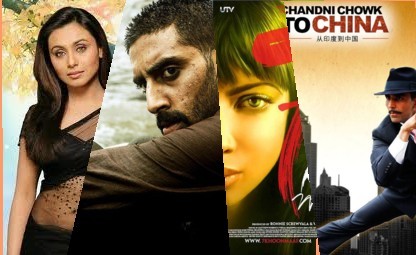
However, it made me reflect about the press coverage all famous actors and directors, sooner or later get and how they deal with it. For example, I remember reading some terrible stories about Rani Mukherjee some years ago. I also remember some of the reviews about Abhishekh Bacchan in Raavan and about Akshay Kumar in Chandni Chowk to China. Actually when they are praising you most, they are also getting ready to pull you down most brutally. Thinking of all the adulation Aamir Khan has received over past few years, I am just waiting to read the kind of bad press he is going to get, the day one of his movie is unsuccessful, how he doesn't understand movie-making, etc.

collage of different films

Everybody knows that movie business is a savage business. The industry forgets you, the day you stop selling. When that happens, film journalists are waiting, ready to pounce on you and sink their teeth in your flesh. The more successful you were, more vicious will be their attacks.

Of course it is not something new. Romans had the colosseum where you had to fight it out with the lions and talibans have public executions where you can take a stone and smash a person's head. All societies have such ways of public fun. We have our actors and directors.

However, I was wondering, how do these actors and directors deal with these kind of stories or reviews? Working in films is considered as glamour, with thousands (or is it millions) of hopefuls dreaming on the sidelines to become famous.  But I think that it must be incredibly stressful.

A big high profile film coming out seems to me like a Board examination. Actually it is worse than that, as there will be different marksheets about the same work. Even if some give you a gold medal, there will be others that will fail you.

How would you deal with it? I can't imagine myself putting in months of hard work and then put myself with my butt in the air, so that critics can do their knife throwing practice on me, carving out rump steaks, if they so desire.

In my office, if I give judgements like this on my colleagues or subordinates, probably I will be hauled before a labour tribunal and told to pay damages. You are suppose to respect human dignity of your fellow workers. Even film critics must be asking for dignified treatment from their bosses and their colleagues, where they work. But all these rules don't apply to public figures and artists, who can be mocked at will, their work can be laughed at.

The more vicious you are in criticising, more people will come to read you. For all the frustrations of our lives, we need to see persons who can be kicked at till they bleed. If they are richer, more famous and more beautiful/handsome than us, the better we feel.

So perhaps the trick is not to take it too personally! That review is not about you. It is about us. Just chill and enjoy your fame while it lasts.

***

New humanism and role of multi-religious societies

This article focuses on changes affecting the religious beliefs of people, that are shaping our world.

Collage representing different religions

Introduction

Different forces are changing our world all the time. We make all kind of theories about these forces and how these are going to change our world and then something new comes and sends all our theories haywire. Not that it stops us from making new theories!

Over the past few decades, the forces of globalization and the changes in geo-political equilibriums with emergence of a multipolar world where China, India, South Africa, Brazil, Russia and many other countries of Asia, Africa and Americas are finding their voices, have also promoted wide social changes that could lead to new unpredictable scenarios.

The crises of raw materials and food on one hand and the dangers of environmental damage, vie for attention along with the advances in genetic mapping and manipulation, development of new technologies like nanotechnologies, the information revolution, etc. At the same time, the last decades have seen increasing polarisations in religious feelings in different parts of the world. These are among the significant forces shaping the world of tomorrow.

The factors that are influencing and shaping our world are so many and so different, that a wider view of everything and making predictions about future is probably unrealistic and foolhardy.

Three broad trends related to religions

I can think of three broad trends related to the principle world religions over the past 3-5 thousand years:

(1) Infinite variations in religious beliefs is common in all major religions of the world: Looking at the way different religions have evolved, it seems inevitable that each religion tends to develop branches that move in different directions. These religious offshoots can be more or less important over periods of times.

Sometimes these religious offshoots are in conflict with other offshoots, that means conflicts with persons of their same religions. Often each branch of the religion feels that it represents the "true" sense of that religion, while others are betrayers or imposters.

At other times, these offshoots, called sects or some times separate religions, can co-exist in peaceful harmony, and even try some kind of dialogue and collaboration.

No religious group can claim to be exempt from this general rule. In addition to differences between different sects or offshoots of a religion, additional geographical differences also develop, that differentiate people living in one place with those living in another country. For example, Catholics in Spain may have some differences compared to the Catholics in Philippines.

Some examples of different sects (or new religions) developing in a religion are:

The sub-groups among Hindus are innumerable, from Shavities, Vaishnavites, followers of Ram and followers of Krishna. Often the differences in religious beliefs about powers of specific deities, do not exclude respect and worship of other deities, so that fosters infinite variety of beliefs and "encroachments" in to other religious traditions.

Some of the more prominent sub-groups among Muslims include Shia, Sunni, Bohra, Ahmadiya, Deobandi, Wahabi, Ashrafs, Ajlafs, Sufi, Hanafi, Shanafi'i, Maliki, Hanbali, etc. The "distances" among some of them are considered big and thus some of them are not even considered as "Muslims" by other groups.

Some of the more prominent sub-groups among Sikhs include Khalsa, Amritdhari, Nanakpanthi, Sahajdhari, Akali Nihang, Nirankari, Namdhari, Radhasoami, 3 HO, etc. The "distances" among some of them are considered big and thus some of them are not even considered as "Sikhs" by other groups.

Similarly Christians include Catholic, Orthodox, Syrian, Jaocbites, Malabar, Methodist, Jehovah's witness and other innumerable groups.

I don't know all the details but I can imagine that Jain, Buddhist, Parsi, Bahai, Jews and other religions, all have some sub-groups.

(2) In all religions, some groups, especially the more orthodox and conservative among them, try to have a dominating role, claim to be the only real religion and dictate rules for the others: This seems to be another common feature of all religions, that more conservative groups among them provoke very strong feelings in their followers and they feel it like their life's mission to ensure that all others follow the "true" path and punish those who try to deviate from the path.

Often such groups come to use violence, verbal or physical, to impose their will on other groups. Usually, they also ask the State to use their religious principles to guide the laws of the country.

(3) Rise of a new humanism among a cross-section of persons in a wide number of countries, influenced by ideas of human rights: Over the past three decades, my work has given me the opportunity to visit a large number of countries in different parts of the world, and increasingly I have met persons of different religions, who share some common beliefs. They believe in terms of individuals' rights, irrespective of their religious beliefs, to live fulfilling lives with dignity.

Some times, their beliefs go against traditional religious beliefs of their individual religions, in areas such as role of women at home and in society, role of religion in the life, possibility of living in co-existence with other religions, role of religious education in their children's lives. Many of them look to and accept the basic principles of Universal Declcaration of Human Rights.

With globalisation and information technology, there is rise in opportunities for social interaction with people of other countries, cultures and religions. TV and films, newspapers and magazines, often talk about and show these relationships and interactions. For example, people from different parts of same countries or from different countries fall in love, some of whom, also marry and set-up multi-religious families.

I like calling this phenonmenon, the new humanism of religions. This new humanism is linked to a crisis of traditional religions, especially in industrialized societies that had strong economic development and a shift from rural to urban societies over the past couple of centuries.

I think that the rise of new humanism of religions is closely linked to the desire of domination by more conservative religious groups to impose their way of religious thinking on everyone. Communities and persons, who have held power for centuries are being threatened by the rise of new humanism of religions.

Challenges of orthodoxies for the future

Over the past couple of decades, slowly issues related to orthodox and conservative versions of Islam have occupied centre-stage of global debate. About 15-20 years ago, Afghanistan, Iran and may be Kashmir in India, seemed like the flash points of Islamic conservatives. Over the past decade, situations in Somalia, Sudan, Nigeria, Yemen, Pakistan, Bangladesh, Iraq, etc. has become more problematic , as country after country (or part of a country), adopts Shariat based laws. Invariably, in such places, communities are dominated by more orthodox and conservative elements and more progressive Muslims as well as minority groups of other religions, face increasing violence and marginalization.

Now as dictators that guaranteed some kind of check on radical Islamic groups in Tunisi, Algeria and Egypt, are being toppled and civil societies are hoping for more democracy, there are increasing fears of rise of these radical Islamic groups. I have heard of stories of violence and verbal assaults against Coptic Christians in Egypt. Situation in Pakistan, after killing of Taseer, seems to be getting worse. Thus fears among minority groups are running high.

M. K. Bhadra Kumar, scholar of political Islam, on Indian Punchline had recently written, "What happens in Egypt will determine the course of Middle Eastern history... Muslim Brotherhood is waiting in the wings as the flames of anger spread in the Middle East."

Many of my Muslim friends insist that Islam is a religion of peace and that Prophet Mohammed never condoned violence on the innocent. However, in the situation today, perhaps the real message of Holy Kuran does not matter. What matters more is how in country after country, the name of Islam is used to silence dissent, conformism to the ideals of "true Islam" proposed by the radical group is compulsory for everyone.

Conservative hardliners were always there in other religions too. Neocon Christians in USA, the conservative hardliner Jews in Isreal supported by groups in USA and other parts of the world, the supporters of Hindu rashtra in India, the Buddhist supporters of Singhalese forces against the Hindu Tamils in Sri Lanka, the examples don't lack. Conservatives of other religions were always there.

I don't know if the expansion of conservative hardliners in other religions can be attributed only to rise of conservative Islam. However, whatever, other reasons are there, the rise of conservative Islamic groups is going to strengthen this tendency.

What answers can we give?

I believe that we need to have robust examples of different models of religious co-existence. We need to show that conflict is not the only way and that new humanism of religious co-existence can be a better alternative for future of mankind.

The societies that are truely multi-ethnic, multi-cultural and multi-religious, especially India, need to support all progressive forces from different religions, in presenting alternative models of religious co-existence.

If we look back in history to the periods when conservatives of a religion dominated and influenced the whole world, probably we can look at the rise of orthdox Christianity in the period called as "the dark ages". It stopped human and scientific progress for hundreds of years and led to tragedies of inquisitions, crusades, annihilation of millions of indigenous people in different parts of the world.

The rise of orthodoxy and conservatives, would have an equally damaging impact on human rights, science and progress of millions who live in these countries and their impact will be felt in the remaining world. In the present age of information technology and globalization, how many decades or centuries would these theocracies last, who can tell?

John Butt, an Islamic scholar, in his article "A passage to secularism" in Hindustan Times of 27 January 2011, had written:
The havens of Islamic learning in India are still intact. They are vibrant, not politicised or radicalised. Some of them are admirably progressive, shunning the traditional abhorrence of secular subjects and incorporating them into their curriculum. Not only would students from Afghanistan be exposed to a progressive strain of Islamic learning if they were allowed to come to India for their religious studies, but they would also see religious education as it once was: learning not to fulfil any political agenda but for the sake of learning itself.
I have many Muslim friends from Indonesia, Bangladesh and Pakistan, who believe in progress and human rights, but I am afraid that in the coming future, their voices are going to be increasingly marginalized and it is going to be increasingly dangerous for them to speak of peace and co-existence with other religions, and to safeguard the human rights and civil liberties of many groups, especially women.

If these lead to reactions of more conservatism from other religions, we are also going to see even more conflicts.

Only India can have that strength with its 900 million Hindus, 120 million Muslims, 30 million Christians and millions of followers of almost every world religion, to oppose such a model of radical and conservative religions, with an example of progress, liberty and peaceful co-existence of different strands of religions, with equal dignity to other religions. But for this India needs to oppose the strengthening of conservative voices, and is that really feasible in the present political scenario?

M. K. Bhadra Kumar, scholar of political Islam, on Indian Punchline  had written about the controversy related to Ghulam Mohammed Vastnavi from Deoband:
How nice if Pakistani madrassas had Vastanvis! Iranian madrassas are full of Vastanvis. How nice if madrassas taught management sciences and the scholars in Deoband ‘googled’ after their evening prayer and supper in the seclusion of their chambers in search of the mysteries of biochemistry... It is atrocious that Vastanvi has no defenders among our national leaders. We shouldn’t repeat the mistake that Pakistan made - remaining silent when we ought to speak. That the Muslims of India do not remain the pocket borough of self-seeking men and politicians and instead move forward is also a national issue. The onus is particularly on our secular political parties to help Deoband move forward with the times.
Given the situation of politics, probably we can't expect our politicians to take sensible action and a stand on progressive ideals. With the vote-bank politics that dominates India, it is going to be impossible to expect India's political leadership to show the required maturity. They have always bowed in front of conservative orthodoxies. This puts a special onus on civil society.

Civil society in India and other multi-religious countries, need to look for ways that show that different religions are not monoliths, but are full of diversity and different ways of interpreting the faith, are all equally important and legitimate. They have to fight against conservatives and hardliners of different religions.

It is only people and civil society that can find a way to ensure that rich diversity, millenniums-old Indian traditions of giving refuge to world's persecuted religions and its history of living together of different religions, can be safeguarded and shown to the world as an example of building new societies. Doing this is imperative to future of India. It will also be important to show to the rest of the world, that an alternative way of co-existence is possible.

***

Ancient world history in Indian scriptures - Introduction

This is first part of an article in 3 parts on ancient World History and Indian history. It looks at the ancient history of world and India, given in Hindu sacred books including Veda, Puran and Brahman stories, based upon the works of an eminent Hindi writer, Acharya Chatur Sen (1891-1960). Part 2 explains the context of writings by Sen, while part 3 presents the main ideas of world history in Sen's work.

Introduction to some works of Acharya Chatur Sen

Acharya Chatur Sen, a trained Ayurvedic doctor, was a prolific Hindi writer and published 186 books including 32 novels, more than 450 short stories, and many non-fiction books on themes as diverse as politics, history and Ayurveda. Apart from a strong interest in ancient Hindu sacred books, he also wrote about hisotry of Islam in India.

Acharya Chatur Sen, eminent Hindi writer

I have read two of his works related to ancient India -

(a) Vaishali ki Nagarvadhu (वैशाली की नगरवधु, The courtesan of Vaishali, first published in 1949 by J. S. Sant Singh and Sons Delhi for Hindi Vishwabharati) about a courtesan called Ambapali during the time of Gautama Buddha, a few centuries before Jesus.

(b) Vayam Rakshamah (वयं रक्षामः, We are Raksha, first published in 1955; from the edition published by Rajpal and Sons, Delhi 2009) about Raavan, the mythological king from Ramayana.

Each of these books carries a long list of ancient texts that were consulted by Chatur Sen for writing that book. Vaishali ki Nagarvadhu, the first book in this series, was dedicated to Jawaharlal Nehru and in preface of this book Chatur Sen had explained that though a work of fiction, the book was attempt to remove the "black curtian that has hidden the defeat of religion, literature, royal governance and culture of Aryas, and the win of progressive cultures of mixed races, during thousands of years, that have not been tackled by historians." He had also explained that writing that book had taken "ten years of research in the cultures of Aryas, Boddh, Jain and Hindus".
dedication to Nehru, Vaishali ki Nagarvadhu, Chatur Sen
By the time, "Vayam Rakshamah" came out in 1955, Chatur Sen was 63 years old and not keeping very well. In the dramatic preface of this book, Sen declared that "he had put in all the learnings and knowledge, both emotional from his heart and logical, from his brain, into writing this book and he had no more left to contribute." About his own mental condition he had written, that like horses, bulls and donkeys, who can die while pulling heavuy burdens, he might also die because of burden of writing this book."

At that time, he was also worried that his depiction of ancient history of Aryas and other races may not be accepted easily as it touched on areas that can be seen as obscene. At the same time, he felt that he had to speak the truth as he had understood it from the studies of the ancient Hindu books:
In this book, I have presented the forgotten word-pictures of different human clans such as Nar, Naag, Dev, Daitya, Danav, Arya, Anarya, etc. from pre-vedic times, who had been seen through the coloured lenses of religion and mythologised into gods of the heavens. I have the courage to present them as human beings. "Vayam Rakshamah" is certainly a work of fiction, but at the same time it is the result of deep study of Ved, Puran, philosophy and foreign texts ... it the summary of my life's work.

Cover, Vayam Rakshamah, Chatur Sen
This book was accompanied by an accompanying explanatary book, to justify and reference whatever he had written in the book, with notes from different sources that Sen had studied.

Upinder Singh in "A history of ancient and early medieval India" (Dorling Kindersley India, 2008) had written, "History is not one but many stories, only a few of which have yet been written. ... there are two parallel images of ancient South Asia - one based on literary sources, the other on archeology." About the ancient texts, Singh wrote, "Ancient texts are much older than their surviving scripts, and have alife of their own. They have grown and changed over time, and this process of growth and change - the period of composition - could in some cases have lasted for hundred of years before they were compiled or given a more or less final shape."

The descriptions of ancient Indian and world histories, from analysis of ancient Indian texts, have been attempted many times, by scholars from different disciplines, from India and many other countries. Continuing archeological excavations as well as new technologies such as satellite mapping imaging, have provided new corroborative evidences to the the different theories.

Still I think that it could be interesting to look at the conclusions about the ancient world events during prehistorical times, at which Acharya Chatur Sen had arrived through his decades long studies. I don't think that people have seriously taken a systematic look at the literary works of Indian authors writing in Hindi or other Indian languages, in terms of analysing their ideas and their implications.

This article is mainly based on the descriptions in Sen's book, "Vayam Rakshamah".

(End of part one of a three parts article)

Note: Special thanks to Sanjay Bengani and Sameer Lal for the image of Acharya Chatur Sen!

Progressive Muslims in Pakistan and India

As we approach the Republic day, the long article of Ramnath Guha in the new issue of Outlook makes for sombre reading about threats to "Idea of India" and the state of India's nationhood. Guha always makes for very interesting reading, and though he seems to end on an optimistic note, I don't know how India can find a solution before the damage to its social and enviornmental fibre won't be irriversible.

However, it was something in the two articles related to Muslims in India and Pakistan that caught my attention, and is the focus of this post's question.

Mariana Baabar, in her article "The Flickering Flame" on the fear in liberal Pakistani society following the assassination of Salman Taseer, has written:
This question has again become a subject of fervent debate from the time Punjab governor Salman Taseer was gunned down and the shocking feting of his assassin, Malik Mumtaz Qadri, who was outraged by his victim’s support for amending the blasphemy law. For someone to be killed for an opinion, an idea, has jolted Pakistanis into reflecting over their journey backward—from liberating progressivism to stifling conservatism. Recalls journalist Adnan Rehmat, “In the ’60s and ’70s, you could even eat at restaurants during Ramadan and see women in saris and bell-bottoms in the bazaars. Burqas and beards were a rare sight.” The socio-cultural transformation has prompted many Pakistanis to think of emigrating. This sentiment was articulated last week in the Dairy of a Social Butterfly, a popular satirical column of the Friday Times. The Butterfly’s husband, Janoo, tells her why they should quit the country, “Tomorrow, someone could pass a fatwa against you for not covering your head. And when a grinning bearded murderer guns you down, lawyers will come and shower him with rose petals.”
In another opinion article on the website of Outlook, Yoginder Sikand writes in "Beyond Sachar" about the role of Muslim religious and civil-political leaders in the state of Muslims in India, a role that he feels was not sufficiently explored in the Sachar report, and writes:
In the wake of Partition of India, a large section of the then Indian Muslim leadership, consisting mainly of the landed aristocracy as well as the middle class intelligentsia, particularly in north India, where the bulk of the Muslim population was concentrated, migrated to Pakistan. The Muslims who remained behind were largely poor and illiterate, the vast majority of who belonged to the so-called ajlaf, descendants of ‘low’ caste converts, whose economic, social and educational conditions had not changed appreciably despite their conversion to Islam. With their political influence, financial resources and access to new forms of knowledge, the landed aristocracy and, especially, the modern-educated intelligentsia could otherwise have been expected to play a key role in promoting internal social reform among the Muslims, as some of them indeed had in the years before Partition. But with their migration to Pakistan, this was rendered impossible. The leadership vacuum created by their departure was soon filled by a different class of men—mullahs, representing a variety of rival Muslim sects, educated in traditionalist madrasas. Many of them, particularly of the Deobandi variety, had been close allies of the Congress party. Today, the vast majority of Muslim organizations that claim to speak for Islam and for the entire Muslim community are led and dominated by mullahs belonging to various sectarian groups—the All-India Muslim Personal Law Board, the All-India Milli Council, the two or more factions of the Jamiat ul-Ulema-e Hind, the Jamaat-e Islami, the Jamiat-e Ahl-e Hadith and so on.
Thus Sikand identifies, one of the reasons of the backwardness of Muslim leadership in India and its lack of sufficient social reforms, in the migration of more educated and liberals Muslims to Pakistan. Yet as Baabar's article points out, this did not help Pakistan to create a more reformed and progressive society. Why and how did that happen?

I feel that the problem could have been also in the decisions of the progressive and liberal Muslims to leave for Pakistan, because it underlined that their progressiveness and liberalism were less stronger than the idea that religion is more important in a society.

Once you choose religion over other human values, you lay the foundations of a society that is unable to rise above religion? What do you think?

So much hoo-ha about a drink?

Outlook has a long article on drinking and bars in India, and how the drinks culture has spread and changed in India over the past two liberalized decades. It made me think about differences in Indian and Italian attitudes towards alcoholic drinks.

I have a feeling that the attitudes towards social drinking in India are very much influenced by British-American attitudes towards alcohol. In the article in Outlook, Anvar Alikhan gives a list of characteristics of a good drinking place:
.. what exactly makes a good bar? It’s a complex, personal issue: what a 22-year-old girl would look for would naturally be different from what a 44-year-old male would want. However, certain basic, universal requirements generally apply, such as:

- First, a good drinks menu, with a sufficiently wide selection of good drinks, poured generously.
- There should be a great bartender. He doesn’t have to be a circus juggler, but he must be good at his job, able to mix interesting, innovative cocktails.
- Probably the single most important factor is that the crowd should belong to your “tribe”. Not necessarily people you know, but the kind of people you’d like to know. That’s what gives you a sense of belonging, and makes you want to come back here next time.
- The place must be 60 per cent full. Less than that and it’s uninvitingly empty; more than that and it’s too crowded.
- The service must be efficient, anticipative and unobtrusive. You shouldn’t have to keep waving out for a waiter.
- The music must be interesting, with a mix of familiarity and slight surprise. And the volume must be just right: not so loud that you can’t figure out what your companions are trying to say.
- Great lighting can make a huge difference to any bar.
- Comfortable chairs. Un-ergonomic furniture soon becomes a pain.
- The prices can be premium, but they should never leave you with a feeling of being ripped off.
- A distinctive character, a sense of history, or even a slight eccentricity always adds something special to a bar.
- Ultimately, no bar ever attains perfection. And if it did, it probably wouldn’t be any good anymore. Some small imperfection is always interesting.
My attitudes towards bars and social drinking are obviously influenced by my living in Italy, the original bar country, where there are bars at every corner and where in some areas, small kids, especially in rural areas, get to taste few spoons of wine from a very tender age, and where there are often discussions on nutritional values of wines and local liquers.

In Italy, when people want to go to a bar, they usually go to the one closer to their homes or their work places, or on the way from the home to the work-place, especially where it is easy to find a parking. Here, people go to the bar throughout the day - in the morning for a cup of coffee and a cornetto for breakfast, for another cup of coffee around mid-morning, for a sandwich for lunch or dinner. In all these occasions, some people will also ask for wine or other drink. Some times, usually in winter, some will ask for a drop of Grappa, the Italian grape liquer, in their coffee. So I feel that the relationships with the bars are very different from the ones described above by Alikhan, it is much more familiar.

Thus even attitudes towards drinking are quite matter of fact, and I have never heard of persons talking of good bars and bad bars. May be they talk of clean or dirty bars, or, they talk of friendly and unfriendly barmen/women.

The main differences between Italian attitudes and Indian (and British) attitudes towards drinking seem to be that in Italy, most persons drink wines every day with dinner, and on weekends and holidays, also during lunch. If you are invited by friends to lunch/dinner, you will get offered invariably some light appettizer drinks, then have some good wine with food and then finally have a selection of liquers for after-dinner drinks, that will usually end with a "digestive", that is a bitter tasting liquer with some herbs in it.

In a bar, in the evening, if you are with friends, you can try some exotic looking cocktail, for some social drinking. I think that women go more for this kind of drinking.

Beer drinking is not so common in Italy. Younger people drink it more. Some times, especially on hot days, people will offer you a bottle or can of beer, or you will order beer for drinking with your pizza. But most drinking is done with food or after-food and focuses on wines. I have also not seen persons drinking umpteen bottles of beer to get drunk, like it happens in Africa.

You hardly ever mix water or or soda or even ice in the hard liquers in Italy. I have yet to meet someone here who starts his drinks every evening, before dinner, with two or three pegs of hard liquer, usually whiskey, mixed with water/soda, accompanied by some snacks, that is so ubiquitous in India.

Most important difference in the attitudes towards alcoholic drinks between Italy and India, seems to be the aura of something bad or prohibited that surrounds drinking in India, in spite of the liberalization and changing attitudes in the recent years. The peripheries of cities like Bangalore, are full of seedy looking, dirty and ill-lit drinking joints, where you "hide" to drink. While in Italy, it is more of a common pleasure of life, taken for granted, sips offered to children and to growing up adolescents much like tea in India, and at the same time, that avoids hard drinking.

I have been fortunate with drinks, because invariably the first glass of anything remotely alcoholic is enough to make me sleepy, so usually I tend to avoid drinks. Having half a glass of red wine is usually enough for me! Drnking also makes me more melancholic and introverted. For me, a good bar will be where it is not too crowded, that has no loud music so that people can talk and that does not allow smoking.

Every country has its drink-culture and probably our colonial pasts mixing up with our specific cultural backgrounds, do influence those drinking-cultures. The Mongolian way of seriouly drinking vodka on every occasion or the Caribbean way of having rum or the German love for beer, are very different from the drinking cultures in India and Italy.

However, I think that I need to remember the Indian habits towards drinking when we have guests from India. This means that I must make sure to have whiskey, soda, ice, snacks, etc. and offer it for pre-dinner drinks. I usually forget it and I don't think that our Indian guests appreciate the Italian way of having some light appettizer, wine with food and an offer of post-dinner drinks or digestives!

Usually for an evening with friends, I would prefer to be with at home. We have a good selection of liquers from different countries. This way, no body tries to insist and force me to drink anything and at the end, I usually drink some wine and may be some digestive. And, best of all, after the evening is over I can go straight to sleep!

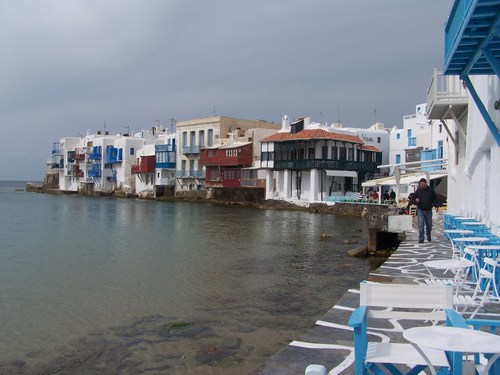
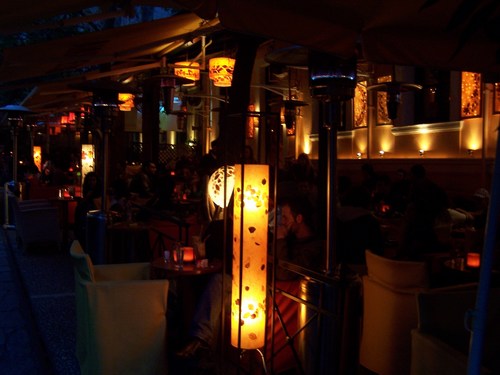
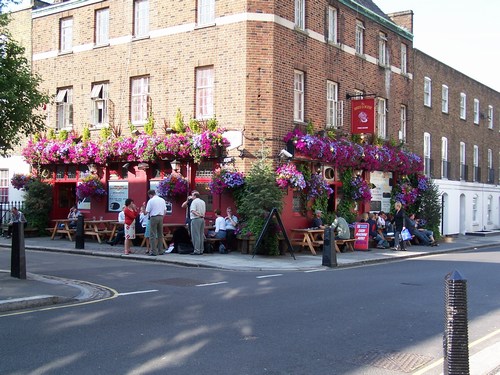
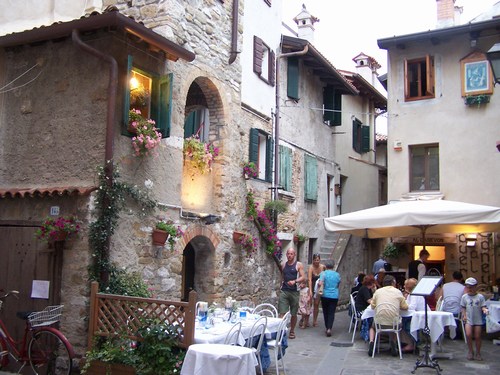
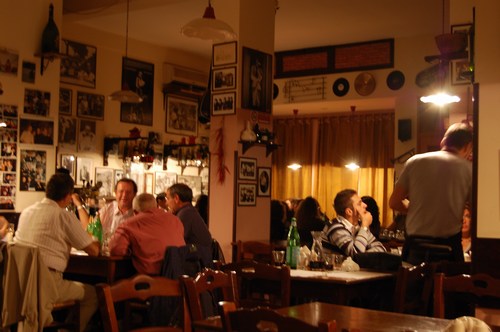
To conclude this discussion on drinks and bars, here are some of my pictures of pubs, bars, bar-restaurants from different countries of Europe:

Having a drink in Europe - pubs and bars

Reliving teenage dreams in Florence

Even after decades, can we ever forget those first giddy confused times, when our bodies changed, hormones were raging and suddenly we thought that we were in love with some one, and the world seemed stronger, sharper, more colourful?

And then, how does it feel when many years later, suddenly you find yourself sitting in front of one of your old dreams? It happened to me yesterday and I felt confused, stuttering and giddy, as if I had gone back to being sixteen once again.

But let me start from the other things, before telling you about my meeting with my teenage crush.

Yesterday, 8 December was the day of Rahul Bose and Onir's new film, "I am" in River to River film festival in Florence, Italy. River to River is the most important festival of Indian films in Italy since 2001 and is directed by Ms Selvaggia Velo. This year it has an important retrospective of Satyajit Ray's films.

Rahul Bose has five of his films in the festival this time - Split wide open, Every body says I'm fine, Mr. and Mrs. Iyer, I am and The Japanese Wife. I had already seen Every body says I'm fine and Mr. and Mrs. Iyer but still it was good to see them again.

I had not seen Dev Benegal's "Split wide open" and I loved it. It has plenty of scenes that usually create great scandals in Indian media including, plenty of Hindi cuss words, two integral nude scenes of Bose, a steamy sex scene and even a scene where the mumbai mafia don takes out his dick hanging it in Bose's face. So they must have talked a lot about this film when it had come out in 1999. However, I hardly knew anything about it and so had started watching it without too many expectations. If you have not seen it, get hold of a DVD and watch it.

River to River festival 2010, Rahul Bose, Selvaggia Velo

In the picture above, Bose is answering questions by the audience after the film. Next to him are Selvaggia Velo, festival's director and the English/Italian translator (sorry for not asking her name).

I had a conversation with Bose, that focused mainly on his involvement in the NGO called The Foundation, and touched superficially about his films.

Coming out of hall, I ran into Rizwan Siddiqui and Vijay Singh. I had seen Rizwan's short film "Kharboozey" on 7th. Vijay introduced himself and told about his works including a film called Jai Ganga. I need to look for his works and see them. Rizwan lives in Lucknow and Vijay is based in Paris.

River to River festival 2010, Rizwan Siddiqui and Vijay Singh

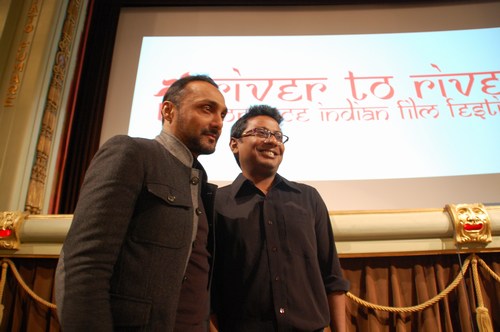
Then it was the time for the Italian premier of Onir's film, "I am". Here are film's director Onir and one of the actors, Rahul Bose.

River to River festival 2010, Rahul Bose, Onir

The film is beautiful and as usual for Onir's films, has beautiful music. Made of four inter-related stories, characters from each story spill off into others, the film touches on some of the sensitive issues including child abuse, homosexuality, artificial insemination and conflict-religion issues. The stories are based on real life incidents. Onir was telling that it will probably release in India in February 2011. Don't miss it.

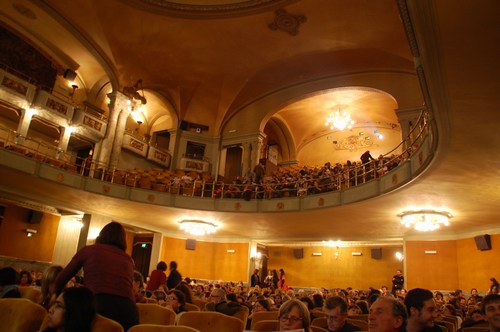
The cinema hall where they are holding the main festival, Odeon, is one of the historical old-style theater of Florence. Yesterday, for "I am" it was full.

River to River festival 2010, cinema Odeon Florence

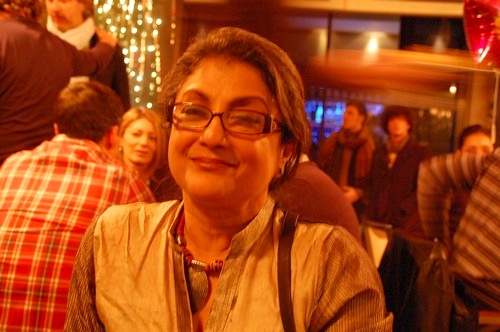
Now about my coming accross one of my teenage dreams, Ms. Aparna Sen. Her "Iti Mrinalini" opened the festival and her "The Japanese wife" is going to close the festival today evening (9 Dec.).

I had read lot of her interviews and had thought of asking her a lot of questions. But in front of her, I felt confused and forgot half of my prepared questions. I don't remember what she answered and probably I was a very distracted interviewer, asking something, then interrupting her, and all the time sneaking looks at her! Hopefully she is used to men like me and didn't take me for being exceptionally stupid or clumsy.

The evening after talking to her, passed in a daze. Couldn't have asked for more! Thanks Ms. Sen.

River to River festival 2010, Aparna Sen

If you wish, you can see Aparna Sen's Question-answer sessions after Mr. and Mrs Iyer at the festival on Youtube. On the same page, you can also find links to videos of Rahul Bose answering questions.

***

Circle of history

A few days ago, there was an editorial in the French newspaper, Le Monde, that talked about exodus of christians from different countries dominated by Muslims. This editorial started from the news of an attack on a church in Baghdad, during which 50 people had died, most of them women and children, and it lamented the flight of christians from the very places where christianity had started.

About 50% of Iraqi christians have left the country in the last 20 years. According to Samir Khalil Samir, a gesuit priest from Egypt, in the last century, christians in Turkey have gone down from 20% of the population to 0.2% of the population, and globally in middle east, they have reduced from 15% to 6%.

Apart from the on-going conflicts in many countries of this region, the spread of more intolerant forms of Islam have contributed to this decline.

Religion, especially a conservative version of Islam, has become a key factor of conflicts in countries like Sudan and Nigeria. In most of these countries, the conservatives have occupied the centre-stage and speak more loudly, while the space occupied by moderates and liberals seems to have diminished.

There have been similar changes in Pakistan and Bangladesh. I remember reading a discussion among bloggers from Bangladesh, who recognized that Durga Puja celebrations in their countries have become rarer and more problematic as their societies are increasingly dominated by conservatives.

It also made me think of the on-going conflict in Kashmir, and the recent controversy surrounding the speech of Arundhati Roy.

I admire Arundhati Roy and I think that it is important that persons have the freedom to talk about uncomfortable truths, that we would rather forget or not see. In this sense, I share her anguish about the continuing lack of civil liberties in Kashmir, about the military rule that does not need to give any explanation or justify its brutality.

I think that power, that does not need to justify itself against people who have no way to raise up their voices or protest, invariably leads to abuse, repression and brutality. The examples of abuses by soldiers in Iraq and Afghanistan recently exposed on Wikileaks confirm this. Not just military, even children growing up in institutions in different cultures and religions know this very well, that pious and apparently kind persons governing them can also abuse their power. So it is easy to understand that the more violent components of military get an opportunity to express worst parts of themselves, protected by laws and their power.

However, I am not sure about the idea of "azaadi" in Kashmir if it means that the area will be ruled by more conservative and fundamentalist forces. How do you reconcile the contradiction between two ideals - the ideal of living with liberty and the right to self-determination on one hand; and the right to live in a country where people are free to wear what they want, for women to go to school and work, the issue of human rights as enshrined in universal declaration and that seem impossible in societies dominated by fundamentalists?

I raised this doubt to Dilip D'Souza, who answered that:
The point about freedom yearned for is that you can't second guess what might happen there afterwards. After all, Churchill believed that Britain would turn India over to half-men if they gave us Independence. White South Africa believed Mandela was a terrorist and there'd be widespread black revenge on the whites if they ended apartheid.
I agree with the examples given by Dilip, but it doesn't answer all my doubts. I think that he ignores the issue of religious conservatives holding power. As I understand it, Kashmir valley that is asking for azaadi, is a small place. I don't know if it is bigger or smaller than Bhutan.

I also agree that Kashmir valley needs freedom from the special laws that guarantee impunity to military, Kashmiris need azaadi from the omnipresent "occupying forces", but how do you make sure that they are not taken over by jehaadis and conservatives? How do you make sure that it does not become another Afghanistan or Baluchistan? Or we say, it doesn't matter to us, they asked for it, let them get out of it?

I think sooner or later, history will turn a full circle and more moderate and illuminated ideals of Islam will come back. The middle ages were dominated by fundamentalist christians who launched crusades, conquest of americas and inquisitions, but eventually rennaisance did win and in todays' world, conservative christians do not have that kind of influence or power. Similarly, one day this domination of fundamentalist islam will give way to liberal islam like the ones that continue to flourish in countries like India and Indonesia.

But till the circle of history completes this passage, how do you deal with regimes that restrict their people's lives? Do you just wait and watch? I am quite sure that the Western answers in Iraq and Afghanistan are not the right answers, also because they are tainted with self-interest of power, control and resources.

But is there another way, and should others intervene and how?

The cost of silence

Certain areas of our history have become taboo. For different reasons we prefer to not to talk about them. Instead, only certain conservative groups and political parties can speak about those parts of our histories. But are there other costs to the society because of this silence?

Amitabh Bacchan and the Somnath ad

The angry reactions about it on facebook and blogs alerted me about the Somnath advertisement video of Gujarat Tourism. They also made me curious about the ad. So I watched it on Youtube and was wondering about the reasons that had provoked the angry reactions. I think that the reactions were not about what is said or not said in this ad, they were mainly about the motives behind it.

At one level, this ad can be compared to Obama talking about loss of American jobs due to outsourcing to India or China. Or it can be compared to the Italian northern league party that uses rhetoric and demagogy about “emigrants” to create fear about criminality and national identity. It reminds people about the threats faced by the Somnath temple some centuries ago.

At another level, the ad is a subtle threat, hidden behind nice words and glossy images. That threat is serious, if we look at the history of using such arguments and how such ideas have been used to justify events like the Gujarat carnage in 2002.

I can imagine the marketing managers and ad agency of Gujarat tourism, all very pleased with themselves. Their message is being spread by persons who like it and also by those who hate it. They must be hoping that in the end people will forget the controversy and remember some of those wonderful images of Somnath temple and more tourists will visit the state. Or they have done it on purpose to stir passions and make electoral gains.

Wider issues of discussion on history: However, I think that this episode points to wider issues of different links between history, politics and religion in India, that are not being debated very often.

Can we talk, discuss and argue about historical events including religious conflicts and understand their significance in India, without making it an accusation against one group of our people?

Language in pre-independent and post independent India

In the pre-independence era and even up to 1950s and 1960s, it was still possible to talk about historical events, without worrying if that was going to offend certain groups of population. Perhaps, it was because that people were clear in their minds that they were talking about historical events, things that had happened hundreds of years ago and these were not judgements about persons of specific religious groups today?

For example Jawaharlal Nehru in his "Discovery of India", first published in 1946 wrote:

About 1000 AC Sultan Mahmud of Ghazni in Afghanistan, a Turk who had risen to power in central Asia, began his raids into India. There were many such raids and they were bloody and ruthless, and on every occasion Mahmud carried with him a vast quantity of treasure. A scholar contemporary, Alberuni, of Khiva, describes these raids: "The Hindus became like atoms of dust scattered in all directions and like a tale of old in the mouths of people. Their scattered remains cherish of course the most inveterate aversion towards all Moslems." ... He met with a severe defeat also in the Rajputana desert regions on his way back from Somnath in Kathiawar.

Socialist leader, Dr Ram Manohar Lohia in his article "Hindu and Muslim" (Hindu aur Musalman, 3 October 1963 published by Ram Manohar Lohia Samta Nyas, 1993) had written (my translation from Hindi):

A common misunderstanding in the minds of both Hindus and Muslims is that Hindus think that for the last 700-800 years Muslims have ruled us, they have been cruel and despotic, and Muslims think that, even if those who may be poorest of the poor, for 700-800 years we had ruled and now our bad days have come. .. the truth is Muslims have killed Muslims. Killed, not in spiritual terms but in physical sense. When Tamur came and killed 4-5 lakh persons, among them 3 lakh were Muslims, Pathan Muslims who were killed. The killer was a Mughal Muslim. ... I want that everyone, Hindus and Muslims, we should learn to say that Ghazni, Gauri and Babar were bandits, who attacked us.

Not just about past history, even for more recent events like India's partition, and Kashmir issue, till seventies, there are countless examples of leaders, writers, thinkers from different sides of political spectrum, who expressed themselves in words that, if used today, would immediately provoke unease and sometimes even accusations of being a part of "fundamentalists" or "saffron brigade", because now those areas of our history have become "sensitive" or even "taboo".

Changing context and changing language

I don’t think that anyone would tell the Jews not to talk about holocaust or to the persons of African descent in the Americas, not to talk about slavery.

The medieval period has been an era of Christian fundamentalism. Think of crusades. Think of genocide of natives in Americas, think of Aztec and Inca empires completely demolished and destroyed. Think of “holy” inquisition in southern Europe, where Muslims and Jews were persecuted, tortured and killed, converted by force, their books and knowledge burnt, their temples and mosques razed to ground.

While it all happened in Europe and middle east, it was more or less the same time when Ghazni or other Turkish/Afghani invaders were raiding India, burning, looting, killing people and also destroying Indian temples.

On one hand, it is perfectly legitimate to talk about what happened in crusades, what happened to natives in Americas and about the tortures of inquisition in Europe. There are countless recent books and articles about it and if you talk about it, no one would dare say that you are anti-Christian or a Muslim/Jew bigot. But if you talk of what happened to temples, you could be looked at with suspicion. Why is that?

When and why this change?

All languages change with time and our way of talking about things changes. The fights for civil rights by the blacks in America and South Africa, the continuing fights for dignity by groups such as women and homosexuals and transgender persons, have all focused on words used to talk about them. The "illuminism" of concepts and ideas of human rights following the second world war, have all impacted on what we talk about and in which terms.

Thus, it is perfectly understandable that today anyone talking about groups of persons like women/blacks/gypsies/asians in an inappropriate language is seen with suspicion or distaste. It is perfectly understandable that persons using terms like niggers or cripples are told off clearly to mind their language. Thus, ways of expression that sounded perfectly reasonable thirty/fifty years ago, may be seen as problematic today.

But the change in India in not talking about certain parts of historical events, does not seem to be an issue of language. It is something else.

Thinking back of the events of the past thirty forty years, I think that part of the change may have come from the Khalistan movement in Punjab. It underlined the fact that India could fragment and get divided.

In his "Idea of India", Sunil Khilnani had written of the apparent conviction of the British and many other parts of the world that post-independence, India would break up in different states. However, till the Khalistan issue came up, while there were wars with Pakistan on Kashmir issue, and there were religious riots every now and then in different parts of India, I think that till that time, there were no real fears among Indians about a break-up of India, and it was the Khalistan movement that brought out this fear in to open.

The demotion of Babri masjid in 1992 and the subsequent bomb blasts in Mumbai, followed by more religious riots probably affected the nation's psyche more fundamentally. The Gujarat killings of 2002 with its state sponsored violence, were the final shock that told India that it was moving towards its doom. In this changed scenario, anything that puts into danger the unity of India has gradually become a taboo area, to be avoided at all costs. Thus, all violent traumas of our recent history are to be swept under the carpet, to be hidden away.

Religions and Indian thinkers

I have a feeling that the thinkers and philosophers in today's India would prefer not to talk about religions at all. For them religion and faith is a non issue, or at the most a private issue. Their distaste towards the more conservative religious believers of different religions is clear, though they are more controlled in denouncing the conservative groups among the minorities and much more vocal in expressing their indignation at Hindu conservatives. I remember an article of Ram Nath Guha in Outlook some years ago in this sense, asking us to be more aware and careful of fears of the minorities.

At the same time, past decades have seen increasing violence of certain conservative groups and the state seems unable to do anything to stop them. Thus persons burn libraries because someone has dared to write something about Shivaji or hound persons like Hussein for having dared to paint a naked Saraswati or in the name of Islam, MLAs threaten to kill Taslima on TV. Try to discuss multiple versions of Ramayana and people pounce on you for denigerating their religious feelings. Try to make a film about conditions of widows in early twentieth century and mobs will chase you away. Pose a question about a person called Mohammed in a question paper and they will cut off your hand and university will suspend you for hurting people's religious feelings. Have a negative Sikh character in a film and sikhs will protest. Talk about illicit relationships of a priest and church will protest.

The end result of both things is silence. You can't discuss anything that touches on religions. From the thinkers and philosophers, because they fear it will hurt the sentiments of minorities. From the conservatives, who have their versions of their religions and they dare anyone else to challenge those views.

Impact of this situation

Political incorrectness issue is especially serious in terms of Hindus and Muslims. Today it is politically incorrect to talk about Muslim invaders from Ghazni to Mughals. We can talk about persons like Akbar, if it is about Hindu Muslim unity, but it is better to avoid talking of Aurangzeb, and if you do it, it should be preferably in terms of “he was really not so fundamentalist as he is painted out to be, he was actually helping some temples”. And if we show Muslims killing Hindus and Sikhs in a film or a play, you should balance it by showing that Hindus and Sikhs were also killing Muslims at the same time.

To a lesser extent, similar problem applies to relations with other religions - especially Christians.

Thus, certain aspects of history have become personal property of Saffron brigade or radical Islamic groups – only VHP, RSS, some Maulanas/clerics or others of their side can speak about it and if you talk about it, you are naturally part of some fundamentalists.

Why is that? Why can’t we differentiate between the past and present? Talking about what had happened 400 years ago, doesn’t mean that as Muslim, Hindu, Sikh, Christian communities of today we are responsible of that past. In the history, terrible wars have been fought, terrible things have been done in the name of religion, but as human beings we are capable of changing, and today we can dialogue and reflect about such things without it necessarily reflecting on who we are today and what our religions are?

I also think that it is unfair to lot of persons, who are religious, but are not conservatives or fundamentalist in their thinking, who believe in multi-cultural India and have respect for all religions. Why should they be seen only as part of saffron brigade or Islamic conservatives?

I do believe that majority of people in India, be they Hindus, or Muslims or Christians or whatever religion, are sane persons, who believe in their faiths, but they also respect others, they also bow their head when they pass in front of another’s prayer place. It is a pity that they only have political parties to represent them who are either representing extremists of their religions or those who call themselves seculars but who do not understand or acknowledge anything related to their faiths.

At the same time, I think that cordoning off certain parts of our history, whether it is arrival or Aryans in ancient India or Muslim invasions of medieval India or partition of India in 1947 or killings of Sikhs in 1984 or killings of Muslims in Gujarat in 2002 or killings of Christians in Kandhamal a couple of years ago, does not help us. Silence does not help us.

Reality is never black or white. Reality is not made of one simple story of one killer and one oppressed. It has multiple stories, where religion is just one part but there are many other parts. If we can't talk about them, we are closing off our possibility to understand what happened and why it happened and how can we make sure that it does not happen again.

***